
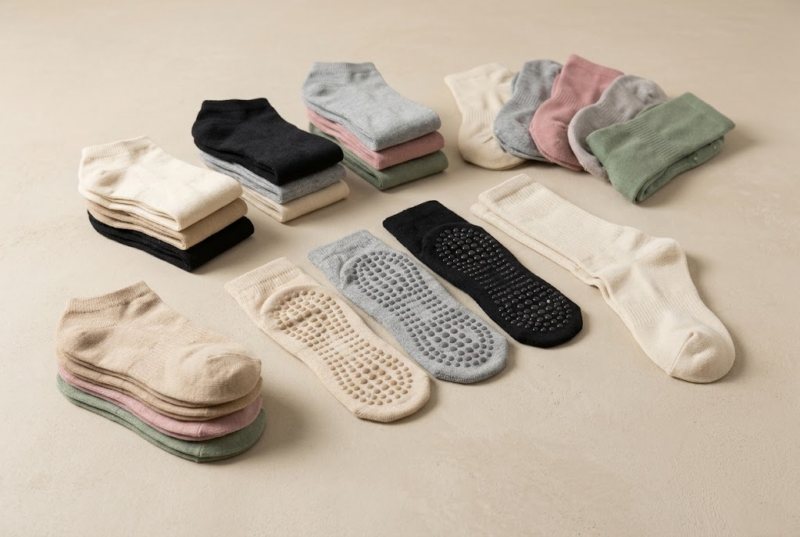
Sourcing grip socks wholesale sounds straightforward until a brand actually sits down with a factory and realizes how many decisions sit behind "just add our logo." Sole pattern, fabric blend, length, and packaging each shift price and lead time in different directions, and private label buyers rarely get a clear picture of that before committing to a quantity. This guide breaks down what a custom grip socks wholesale order actually involves, who typically places one, and how the process runs from first sample to final shipment at a factory-direct manufacturer like Sockcn. TL;DR Customization: Choose your grip pattern, sock materials, length, logo placement, and packaging based on your target market. MOQ: Standard custom grip socks typically start at 100–300 pairs. Molded grip logos may require 500–1,000 pairs due to tooling. Pricing: Larger orders generally reduce the unit cost. Premium materials, custom grip designs, and retail packaging increase costs. Production: Approve a physical sample before bulk production. Standard orders typically take 6–10 weeks from sample approval to delivery. What a Custom Grip Socks Wholesale Order Includes Before pricing or MOQ enters the conversation, a private label buyer needs to settle two physical decisions: what's on the sole, and what the sock body is made from. Both choices get locked in before artwork or branding even starts. Grip Types and Sole Construction Silicone and PVC dot patterns cover most standard orders, offering reliable traction at a manageable cost for studios and venues placing their first wholesale run, while full-sole coverage gets specified when a brand needs maximum grip for high-activity environments such as trampoline parks. A logo molded directly into the grip, rather than printed on the cuff, is treated as a premium build since it requires its own tooling, and that step is usually what pushes MOQ from a few hundred pairs up toward four figures. Grip quality also depends on elasticity and application consistency, not just the pattern itself. One Pilates studio client came to Sockcn after a previous supplier failed to deliver satisfactory grip quality. After testing our samples and finding the grip elastic and well-made, the client decided to move production to our factory. You can read more in our Custom Grip Socks Case Study: Fixing Poor Grip Quality. Sock Body Materials and Blends Cotton-polyester blends keep cost per pair low and suit high-volume entertainment or gym orders where durability matters more than hand-feel, whereas combed cotton with spandex gets chosen by yoga and Pilates brands aiming for a softer, more premium retail product. Bamboo-blend construction has become a common request for wellness and hospitality labels positioning around natural materials, and material choice at this stage affects both unit cost and how the finished sock performs after repeated washing. Private Label Options for Custom Grip Socks Once grip type and fabric are set, branding decisions shape how the finished product actually represents a brand on shelf or at a front desk. These choices add cost in smaller increments than the sole construction does, but they're what customers notice first. Logo Placement and Branding Methods A logo can sit on the ankle cuff, across the top of the foot, or inside the grip pattern itself, and each placement carries different visibility and production complexity. Jacquard knitting bakes the logo into the fabric structure permanently, while printed or embroidered options cost less upfront but wear differently over repeated use, which is why Sockcn walks private label clients through trade-offs for each method before a sample gets produced. Color, Length and Packaging Choices Ankle length remains the most requested option across industries since it suits nearly every use case, though no-show styles get picked by Pilates and barre brands focused on a cleaner look, and crew length shows up more often in healthcare and senior-care orders. Custom header cards, backer cards, or branded poly bags get added at this stage too, and retail-ready packaging is frequently what separates a wholesale grip sock from a giveaway item sold at the register for real margin. Wholesale Pricing and MOQ for Grip Socks Numbers settle faster than adjectives, so a tiered view of how volume and construction affect cost gives private label buyers something concrete to plan around before requesting a formal quote. Order Volume Typical Construction MOQ Behavior Price Trend 100–300 pairs Logo on cuff, dot grip Entry-level MOQ, standard colours Highest per-pair cost 500–1,000 pairs Custom colour blend, premium fabric Mid-tier MOQ, more design flexibility Noticeably lower per-pair cost 1,000–5,000 pairs Logo molded into grip, custom packaging Grip tooling required Competitive bulk pricing 5,000+ pairs Fully customised construction Negotiated terms Lowest per-pair cost What Raises or Lowers the Unit Price Silicone grip, a molded logo pattern, individual poly-bagging, and specialty fibers all push price upward, while standard dot-grip, cotton-poly blends, ankle length, and bulk (non-individual) packaging keep per-pair cost down. Most private label brands end up somewhere in the middle, choosing premium construction on the one or two details that matter most to their customer and standard options everywhere else to protect margin. Who Orders Bulk Grip Socks Wholesale Demand for wholesale grip socks spans more categories than most buyers expect going in, and understanding where a brand's own order sits relative to typical industry volumes helps set realistic expectations with a factory. Studios, Gyms and Wellness Brands Yoga, Pilates, and barre studios remain the most common private label buyers in this category, usually ordering 300 to 1,500 pairs per design to cover both retail sale at the front desk and complimentary new-member gifts. These buyers tend to prioritize a softer fabric blend and clean branding over maximum grip coverage, since their floors are controlled studio environments rather than high-traffic public venues. Hospitality and Healthcare Buyers Boutique hotels, spas, hospitals, and senior care facilities place larger, more frequent orders, often running 1,000 to 5,000 pairs per cycle for guest amenities or patient safety programs. Durability and consistent supply matter more here than branding complexity, which is why many of these buyers move toward standing reorder schedules with their manufacturer rather than
Private Label vs. Wholesale Socks: Which Is Right for Your Business?
Deciding between private label vs wholesale socks shapes far more than how inventory is bought, because the choice sets how much design control, branding, upfront investment, and room for growth a business keeps. Buying wholesale lets retailers stock proven styles quickly, whereas private label socks let a company build a distinctive range under its own name. Working with a sock manufacturer also changes material selection, minimum order quantities (MOQ), sampling, and production planning, so the comparison below approaches both models from a B2B perspective and weighs budget, sales strategy, and long-term product goals. TL;DR Wholesale socks are a practical choice for businesses that need ready-made products, lower upfront costs, and faster market entry. Private label socks are better for businesses looking to build their own brand with custom designs, logos, materials, and packaging. If you want to test the market first and develop a distinctive sock collection over time, combining wholesale and private label sourcing can be a flexible approach. Where the two models differ Both sourcing models let a business buy socks for resale, although control, cost, and brand differentiation differ enough that neither suits every business. Figures in the table below compare them on the factors that shape a range, so private label vs wholesale socks can be weighed against whether speed or brand association matters more. Factor Wholesale socks Private label socks Product selection Existing styles and specifications Existing or adapted styles under your brand Branding Usually supplier-branded or unbranded Your logo, labels, and brand identity Customisation Limited More options for colours, patterns, and packaging Initial investment Generally lower development costs May include sampling and setup costs MOQ Depends on stock and supplier terms Depends on style, materials, and customisation Lead time Often shorter when stock is available Includes customisation and approval stages Inventory risk Useful for testing demand Requires planning around specific designs and quantities Best fit Retailers seeking speed and flexibility Brands developing a distinctive product range Wholesale socks explained Ready-made products bought in bulk for resale define wholesale socks, so buyers choose from available styles, materials, sizes, and colours instead of commissioning development work. This side of the private label vs wholesale socks comparison suits a buyer who wants proven product quickly, though it leaves little room to alter the specification. Lower development costs Because the specification already exists, wholesale orders involve fewer setup and sampling steps than a private label programme. Final costs still depend on quantity, material, construction, packaging, and shipping, which is why the full landed cost deserves attention rather than an assumption that every wholesale option is cheap. Faster stocking and market testing Retailers that need to replenish popular styles or test a new category can start with wholesale, without committing to a dedicated design. A store might begin with several standard crew, ankle, or athletic styles, then use sales data to identify which products deserve further investment. Our sock wholesale price guide explains the main factors behind purchasing costs for buyers planning bulk orders. Less brand differentiation Other retailers may offer similar or identical products, which is the main limitation of buying wholesale stock. Merchandising, pricing, and customer service can still set a business apart, yet the sock itself offers fewer chances to establish a unique identity. private-label brand socks explained Selling socks under your own brand, using products developed or adapted to your requirements, describes the private label model. Depending on the manufacturing arrangement, a buyer may start from a proven sock base and customise its appearance, or specify materials, construction, and packaging in more detail. Branding control Knitted logos, custom colours, jacquard patterns, branded labels, hangtags, and retail packaging can all form part of a private label programme, which keeps a collection visually consistent. Brand-focused development is supported at Sockcn through its custom sock manufacturing service, where materials, designs, and product specifications are discussed with buyers. Greater product differentiation Collections under your own brand can reflect a particular customer group instead of relying on standard catalogue styles, which is where differentiation begins. Lifestyle brands, for instance, might prioritise soft everyday socks, while an outdoor brand could develop wool-blend socks with targeted cushioning and reinforced heels. Material and product requirements can be tailored to different market positions, as our custom wool socks collection shows. Planning before production Clear decisions about artwork, colours, sizes, packaging, and quantities are needed before a private label order can proceed. Sampling and approval may also be required before bulk production, depending on the project. Further detail on the manufacturing stages sits in our guide to choosing a reliable OEM factory for socks How MOQ, cost, and lead time compare Comparing private label vs wholesale socks on cost rarely stops at the unit price, because each model distributes expenses and responsibilities differently, which makes the full order requirements the fairer basis for a decision. Minimum order quantity Whether a supplier sells from available inventory or requires a new production run decides the wholesale MOQ. Across private label projects, MOQ may vary by style, colour, size, yarn, and customisation. At Sockcn, many custom sock projects start at 100 pairs per design, although the actual requirement depends on the specification. Background on these thresholds sits in our guide to MOQ in custom sock manufacturing. Total cost of ownership Development expenses often fall with wholesale purchases, while private label orders can involve sampling, logo setup, custom packaging, and other preparation costs. Commercial sense depends on order volume, product positioning, retail price, and expected sell-through, not on the quoted unit cost alone. Investment and expected margin deserve more weight than the lowest price on paper. Production and reordering Stock that is already available usually ships quickly on a wholesale order. More coordination is needed for private label production, since designs and specifications must be confirmed before manufacturing begins. Once a product has been approved, documented specifications make repeat orders easier to manage. Reorder arrangements differ across private label vs wholesale socks, and production schedules, material availability, and supplier terms should be confirmed before the first order. Which sourcing

Bamboo vs Wool Socks: Which Material Fits Your Private Label Collection?
Fabric choice shapes cost, durability, and positioning as much as softness, because bamboo-derived viscose suits soft everyday socks while merino wool is chosen for temperature regulation and outdoor use. This guide compares bamboo vs wool socks on the price, end use, and construction decisions that shape a private label collection. How Bamboo and Merino Wool Differ When comparing bamboo vs wool socks for a private label collection, brands need to understand how each material behaves in daily wear, how much construction support it needs, and whether its benefits justify the target retail price. Both bamboo-derived viscose and wool can make comfortable socks, though they serve different product strategies. Factor Bamboo-derived viscose Merino wool Hand feel Smooth, soft, silky Soft, springy, naturally textured Moisture behaviour Absorbs moisture; drying depends on construction and blend Absorbs moisture vapour and helps regulate comfort across changing conditions Temperature regulation Suitable for lightweight everyday socks Particularly useful for variable temperatures and outdoor wear Durability Benefits from nylon reinforcement and suitable construction Often blended with nylon to improve abrasion resistance Typical positioning Everyday comfort, lifestyle, value-conscious premium Premium outdoor, hiking, winter, performance Cost positioning Often more accessible, depending on yarn and specifications Generally higher for quality merino yarns These are general tendencies rather than guaranteed results, since fibre grade, yarn structure, fabric density, finishing, and blend ratios can change performance substantially. What bamboo socks offer brands Comfort-focused brands are drawn to bamboo socks because the material's smooth hand feel creates an easy-to-understand benefit for customers. Developers comparing bamboo vs wool socks should still examine the actual fibre composition rather than treating “bamboo” as a complete technical specification. Softness and bamboo viscose Most commercial bamboo socks use viscose or rayon derived from bamboo pulp, a regenerated cellulose fibre valued for its smooth surface and soft feel against the skin. That hand feel suits casual crew socks, dress socks, lightweight everyday styles, and comfort-oriented collections, which keeps the material easy to position. Processing matters here, because bamboo-derived viscose is not the same as mechanically processed bamboo fibre, which means brands should confirm the correct fibre name for product labels and marketing claims. The custom bamboo socks collection from Sockcn offers a starting point for developing branded styles. Moisture absorption and breathability Viscose from bamboo absorbs moisture, and lightweight knitted constructions can provide comfortable airflow for everyday use. Absorption alone does not equal rapid sweat wicking or fast drying, which matters for customers who walk extensively, work long shifts, or perspire heavily. Those wearers need the complete yarn blend and sock structure more than a bamboo label alone, with mesh zones, suitable thickness, and supportive synthetic fibres helping tailor the product to its intended use. Pricing and product positioning Soft-touch products can use bamboo-derived viscose without automatically moving into the price tier associated with premium merino wool. Lifestyle multipacks, gift collections, and comfort-focused retail lines can all use it, because the material fits a soft, accessible proposition. Costs still depend on yarn specifications, order volume, colours, knitting complexity, and packaging, so buyers should compare quotations based on equivalent product specifications rather than fibre names alone. Sockcn’s custom bamboo socks guide covers further development considerations, including construction and blend choices for everyday styles. What Wool Socks Offer Brands Wool is not one uniform material, because traditional wool and fine merino differ in fibre characteristics, and the final result also depends on yarn quality and construction. Brands targeting outdoor or premium customers often treat merino as the more relevant side of the bamboo vs wool socks decision, because the performance story is easier to support. Temperature regulation in merino Crimped fibres give merino wool the ability to absorb moisture vapour while helping regulate the microclimate around the foot. Such characteristics make merino well suited to hiking, travel, cool-weather wear, and products designed for changing temperatures. Fine merino fibres can also provide a softer next-to-skin feel than many coarser wool types, which matters for socks worn directly against the skin. Premium collections can compare different constructions and blend specifications through Sockcn’s custom merino wool socks, which helps clarify the yarn and knit that suit the intended price point. Durability and blend design Warmth and temperature regulation are useful wool properties, but a sock made entirely from wool may not provide the abrasion resistance, stretch recovery, or shape retention required for frequent use. Manufacturers often combine merino wool with nylon for reinforcement and elastane for stretch and fit, which helps a lightweight sock hold its shape without losing softness. Appropriate percentages depend on the intended application, yarn availability, and budget, and should be confirmed through sampling rather than assumed from a standard formula. Cushioned hiking socks worn inside heavy boots may need a different construction from lightweight everyday wool socks, which is why the brief should name the footwear and activity. Higher pricing and customer expectations Quality merino wool generally costs more than standard bamboo-derived viscose yarn, particularly when the product uses finer fibres or specified sourcing and certification requirements. Additional cost makes the most sense when the collection can communicate meaningful benefits, such as temperature regulation, outdoor suitability, and considered material quality. Buyers should not assume that a higher wool percentage automatically produces a better sock, because the full blend, fit, and construction must support the product's price point. A merino wool boot sock product illustrates how wool can be combined with supporting fibres for a defined use case. Matching material to your collection Once the differences are clear, matching bamboo vs wool socks to the customer and sales channel becomes the next decision. Materials that work well for an affordable everyday multipack may be less suitable for a specialist outdoor product, even if both are technically comfortable. Start with the end use Everyday lifestyle socks may suit bamboo-derived viscose when a smooth hand feel and accessible price position are priorities. Hiking, cold-weather, and premium outdoor collections often suit merino wool because temperature regulation and moisture-vapour management are central to the product proposition. High-intensity sports and products requiring fast drying should not be decided

Custom Volleyball Socks: Design Options for Teams and Sports Brands
Made-to-order volleyball socks have to do more than match a team uniform, because they need to stay secure through quick lateral movements and jumps, remain comfortable across training and matches, and reproduce team colours and logos consistently across an entire order. Sports brands, clubs, schools, and distributors all face the same balancing act when developing them, since design preferences have to be weighed against construction, material selection, and manufacturing requirements. This guide explains the main options for custom volleyball socks and shows how a design concept becomes a production-ready product. Choose the right style for custom volleyball socks Height and construction affect both the appearance of a team uniform and how the socks perform during play, which is why these choices deserve attention before colours or graphics are considered. Playing environment, footwear, kneepads, and the preferences of the intended users should all inform that decision. Sock length options Crew socks offer a versatile option for teams that prefer a shorter athletic style, while knee-high socks provide more visible space for team graphics and may coordinate better with certain uniforms and kneepads. Neither option is automatically better for every volleyball programme, since coverage, fit, player preference, and the overall uniform design all shape the right choice. Design consideration Crew socks Knee-high socks Coverage From the lower leg to mid-calf Extends toward the knee Design area Smaller printable area More room for vertical graphics Styling A shorter, versatile athletic look A traditional, more prominent team look Main fit concern Keeping the sock from slipping or bunching Holding a secure fit without excess tightness Match construction to the playing environment Indoor volleyball involves repeated jumping, landing, and rapid direction changes, so fit stability and cushioning deserve particular attention. Outdoor programmes may prioritise lightweight construction and moisture management depending on the playing surface and weather. Sockcn’s custom athletic socks collection gives teams a starting point for discussing performance-oriented constructions with a manufacturer. Photo by Raja Tilkian on Unsplash Fibre blends and performance Material selection for custom volleyball socks influences comfort, durability, stretch, and overall product cost, and a yarn should be judged by the complete blend rather than its name alone. Intended use and construction also belong in that evaluation, because the same fibre can behave differently in a different knit. Select a suitable fibre blend Polyester is commonly used in performance socks because it supports moisture management and quick drying, while nylon can contribute abrasion resistance and durability. Elastane, also known as spandex, helps the sock stretch and recover its shape after wear, which matters for a sock that has to stay in place. Cotton blends may appeal to buyers who prioritise a familiar, soft hand feel, although moisture retention deserves consideration in demanding sports use. Composition should follow the target market, budget, and desired performance rather than a default formula. Build in cushioning and support where needed Cushioning can improve underfoot comfort during repeated jumps and landings, while reinforced heel and toe areas help address common wear points. Arch-support structures and a well-designed cuff can also contribute to a more secure fit around the midfoot and ankle. These features should be specified according to the product’s intended use rather than added indiscriminately, because extra thickness and construction complexity can affect fit inside athletic shoes. Consider breathability and fit together Mesh knit zones may help improve airflow, but ventilation is only one part of the design. A sock must also maintain appropriate stretch, heel positioning, and cuff tension without creating uncomfortable pressure. Teams developing several sizes should request a size chart and test samples across representative sizes instead of relying on a single fit check. Colours, logos, and graphics Image source: Magnific.com Visual consistency across custom volleyball socks is often just as important as physical performance, and a design has to look clear when worn, complement the uniform, and remain feasible to reproduce. Every decoration method imposes its own limits, so the artwork should be assessed with the chosen process in mind. Coordinate team colours Start with one dominant colour for the sock body, then use secondary colours for stripes, cuffs, heels, toes, or accent graphics. High contrast helps logos and numbers remain visible from a distance, while too many equally prominent colours can make the design feel crowded. Pantone references or physical colour samples should be provided where accuracy matters, and the closest achievable yarn colours are confirmed during sampling. Include numbers, names, and pattern details Knitted jacquard designs integrate graphics into the sock structure and can work well for team names, simple logos, and repeating patterns. Printing may suit certain detailed or multicolour designs, depending on the material and production method. Very small lettering, fine lines, and detailed crests may need simplification to remain legible on a curved, stretched surface, so ask the manufacturer what will survive knitting. The custom team socks design guide from Sockcn explains how artwork, sport-specific construction, and production feasibility work together. Include numbers, names, and pattern details Stripes, mascots, initials, player numbers, and short team mottos can make a design more distinctive. Shared designs are generally easier to manage and reorder than individually customised pairs for regular team orders. If personalisation is required, establish which details vary by player and how they will be organised in the order specification before approving the artwork. Sampling and manufacturing Digital mock-ups can communicate the design concept for custom volleyball socks, but they cannot fully demonstrate how the finished sock will fit or how the graphics will look on knitted fabric. Reviewing a physical sample gives brands and teams an opportunity to check those details before committing to bulk production. Prepare a complete product brief Provide the manufacturer with the team logo, colour references, preferred sock height, size range, estimated quantity, and any performance requirements. Reference images or an existing sock can help explain the intended construction, particularly when a particular cuff or heel shape matters. Where the brief includes cushioning, mesh zones, or reinforced areas, their locations should be identified clearly so the development team can assess feasibility and cost.
Custom Bamboo Socks: Options for Your Brand
Developing custom bamboo socks involves decisions about yarn composition, construction, colours, branding, minimum order quantities, and packaging, all of which affect the finished product. Working through these details in order helps brands prepare a clear product brief, assess samples, and plan for bulk production. Choose the Right Bamboo Yarn Blend Yarn selection shapes the design of custom bamboo socks, and the composition needs to suit both the intended use and the budget. Before settling on a blend, consider how the socks will be worn and which performance characteristics matter most to your customers. Understand Bamboo-Derived Fibers Many bamboo socks on the market are made from viscose or rayon derived from bamboo pulp, rather than mechanically processed bamboo fiber. This distinction can affect fiber-content labeling and how the material is described to customers. For custom bamboo socks, confirming the exact composition with your manufacturer helps keep product specifications and descriptions clear and accurate. Select Supporting Fibers for Performance Bamboo-derived viscose offers a smooth feel, while supporting fibers help meet other product requirements. Nylon can improve abrasion resistance, and elastane adds stretch and helps the sock retain its shape after wear. The right blend depends on the intended use, so brands can work with their manufacturer to select a composition that suits their product goals. Match the Blend to Your Product Positioning Everyday lifestyle socks may prioritize softness and comfort, while products intended for frequent wear may require greater attention to reinforcement and shape retention. Cost targets and expected product lifespan also influence the final blend. For more guidance on comparing fiber properties, refer to Sockcn’s sock material guide before finalizing your specifications. Select the Sock Style and Construction Once the yarn blend is established, define the physical design. Sock length, knitting structure, thickness, and fit affect both the wearing experience and the space available for branding. Choose the Right Sock Length No-show and ankle socks suit low-profile footwear and casual collections, whereas crew socks offer more visible space for logos and decorative patterns. Longer styles may suit fashion-led or seasonal products, so consider the intended footwear, target customer, and collection aesthetic when choosing the length of your custom bamboo socks. Define Thickness, Cushioning, and Knit Structure Fine-knit construction can suit lightweight everyday or dress socks, while terry cushioning may be appropriate when underfoot comfort is a priority. Cuff tension, heel shaping, toe closure, and reinforcement in high-wear areas also need to be specified early, because changes to these details can affect sample approval, material consumption, and production costs. Confirm Sizing and Fit Requirements Determine the target size range and the sizing system used in your main sales markets. If the collection covers multiple sizes, provide the intended size breakdown rather than assuming one sample will represent every fit. Brands developing lifestyle collections can also review Sockcn’s custom casual socks guide for additional design considerations. Image source: Magnific.com Customize Colors and Logos Color and branding decisions help distinguish your socks from competing products. Confirming these details before sampling gives the manufacturer a clearer reference for developing a product that matches your brand guidelines. Check the minimum order quantity An initial MOQ of 100 pairs is available for Sockcn’s custom sock projects, making smaller runs possible for brands testing a design or introducing a limited collection. The applicable minimum may vary with the style, yarn blend, colors, and customisation details, so ask whether it applies per design, per colour, or according to another production specification when requesting a quotation for custom bamboo socks. Request and Evaluate a Sample A sample lets you evaluate the yarn feel, dimensions, stretch, cuff fit, color, logo execution, and overall workmanship of your custom bamboo socks against the original brief. Sampling timelines depend on material availability and design requirements, so confirm the expected schedule with Sockcn and document any changes needed before approving the final sample. Confirm the Quotation and Production Schedule The total cost depends on factors such as material composition, knitting complexity, order quantity, branding methods, and packaging. Ask for a quotation that clearly identifies the agreed specifications and any additional charges. You should also confirm the sampling revisions, bulk production lead time, payment terms, and expected delivery date so your purchasing plan is based on realistic timelines. Confirm MOQ and Sampling Color and branding decisions help distinguish your socks from competing products. Confirming these details before sampling gives the manufacturer a clearer reference for developing a product that matches your brand guidelines. Check the minimum order quantity An initial MOQ of 100 pairs is available for Sockcn’s custom sock projects, making smaller runs possible for brands testing a design or introducing a limited collection. The applicable minimum may vary with the style, yarn blend, colours, and customisation details, so ask whether it applies per design, per colour, or according to another production specification when requesting a quotation for custom bamboo socks. Request and Evaluate a Sample A sample lets you evaluate the yarn feel, dimensions, stretch, cuff fit, color, logo execution, and overall workmanship of your custom bamboo socks against the original brief. Sampling timelines depend on material availability and design requirements, so confirm the expected schedule with Sockcn and document any changes needed before approving the final sample. Confirm the Quotation and Production Schedule The total cost depends on factors such as material composition, knitting complexity, order quantity, branding methods, and packaging. Ask for a quotation that clearly identifies the agreed specifications and any additional charges. You should also confirm the sampling revisions, bulk production lead time, payment terms, and expected delivery date so your purchasing plan is based on realistic timelines. Finalize Packaging and Bulk Production Packaging instructions and quality requirements should be agreed before manufacturing starts, so the factory has a clear reference for preparing the order. This reduces the risk of mismatched labels, incorrect packing quantities, or differences between the approved custom bamboo socks sample and the delivered product. Select Packaging for Your Sales Channel Paper bands, hang tags, individual bags, multipacks, and custom retail boxes offer different presentation and

Alpaca Toe Socks: Benefits, Design & Custom Options
Are you looking for a premium sock product that combines natural fiber appeal with a unique design? Alpaca toe socks pair the softness and insulation of alpaca fiber with an individual toe structure, offering a distinctive option for outdoor, lifestyle, and specialty sock brands. This guide covers key considerations for custom development, from fiber blends and knitting technology to durability and production requirements. Quick Overview Material: Alpaca fiber provides a soft hand feel, lightweight warmth, and premium positioning. Structure: Individual toe compartments require precise sizing and knitting control. Development focus: Fiber blend, toe fit, durability, and production feasibility. Customization: Brands can adjust materials, colors, patterns, logos, and packaging. MOQ: Due to specialized yarns and toe sock construction, custom projects usually require higher order quantities. What Makes Alpaca Toe Socks Different? Two elements define alpaca toe socks, and understanding both helps brands make better development decisions. Alpaca fibre shapes much of the material's feel and insulation, while the five-toe structure introduces specific requirements for fit, knitting, and sizing. Alpaca Fiber Characteristics Valued for its softness, its relatively lightweight warmth, and its smooth feel, alpaca fibre is the material half of this product's appeal, and it suits premium sock collections particularly well. Unlike sheep's wool, alpaca fibre naturally lacks lanolin, although comfort still depends on the fibre grade, the yarn processing, and the finished construction. In sock manufacturing, alpaca is often blended with nylon, polyester, or elastane, because pure alpaca fibre socks need that support to deliver the durability and stretch that regular wear demands. Brands comparing the advantages and limitations of this material can explore Sockcn's guide to alpaca socks pros and cons before finalising an alpaca toe sock specification. Five-Toe Construction A five-toe sock separates each toe into an individual knitted compartment instead of enclosing all the toes together, and this structure opens up room for differentiated product design. Every compartment must provide suitable length, width, and flexibility without leaving excess fabric or creating an overly tight fit, and compared with a conventional sock, the additional toe sections also make pattern development and size grading more demanding for alpaca toe socks, particularly when the design uses a premium yarn blend with different stretch and recovery characteristics. What are the benefits of alpaca toe socks? The combination of natural fibre and individual toe construction gives alpaca toe socks their distinctive concept, but each feature serves a different purpose. For brands, the strongest opportunity comes from matching those characteristics to a clearly defined customer and use case, rather than assuming the combination automatically improves every aspect of performance. Softness and lightweight warmth Consumers who want a soft, warm sock without relying entirely on a thick or heavy construction are the natural audience for alpaca wool toe socks, and the actual warmth and hand feel depend on the alpaca content, the yarn characteristics, the fabric density, and the sock thickness. Product developers should still evaluate the complete blend rather than treating fibre percentage as the only quality indicator, and in premium outdoor and cold-weather collections this material profile helps alpaca toe socks stand out, provided the construction also meets the required durability and fit standards. Individual toe separation Separated compartments are what distinguish alpaca toe socks from conventional wool designs, and they suit customers who prefer each toe to be covered individually. By limiting direct skin-to-skin contact between adjacent toes, the structure may help reduce toe-to-toe rubbing in some applications, although overall comfort also depends on footwear fit, moisture management, and sock sizing. Brands developing a wider five-toe collection can review Sockcn's custom toe running socks to see the construction and customisation possibilities of an existing toe sock design. Premium product positioning Pairing a natural speciality fibre with a less conventional sock shape gives brands a clear starting point for product differentiation, and rather than competing solely on price, companies can position alpaca toe socks around material selection, thoughtful construction, distinctive colour combinations, and private label presentation. This approach may suit premium lifestyle retailers, outdoor brands, and niche footwear businesses looking for a product that stands apart from standard cotton or synthetic options. How to design custom alpaca toe socks Once the target market is settled, the material and construction decisions have to come together in a practical manufacturing brief, and making those choices together helps avoid an alpaca toe sock that looks appealing in concept but proves difficult to produce consistently or falls outside the intended price range. Choose the right fibre blend Higher alpaca percentages are not automatically the best choice for every sock application, since nylon brings abrasion resistance, elastane supports stretch and recovery, and polyester or other compatible fibres can earn a place depending on the yarn specification and the intended construction. The right composition should reflect the product's expected use, its target retail price, the desired hand feel, and the performance requirements, with the final blend confirmed through sampling. Brands exploring different natural-fibre constructions can also review Sockcn's custom wool sock collection for relevant material and product development options. Refine the toe fit Accurate toe dimensions are essential in alpaca toe socks because each compartment has to accommodate a different toe length while the overall fit of the sock holds together. During development, manufacturers should assess toe-pocket sizing, stretch, knitting tension, and the transition between the toe sections and the main foot area to catch problems such as bunching or excessive tightness early. Testing the sample with appropriate footwear also helps confirm whether the design delivers the intended fit before the specifications are approved for bulk production. Plan colours and branding Customisation on alpaca toe socks can extend beyond the fibre blend to cover sock height, colour combinations, knitted patterns, logo placement, labels, and retail packaging. However, complex patterns and multiple colour changes may affect machine programming, sampling requirements, and production costs, so visual decisions should be assessed alongside technical feasibility. For brands building a broader collection, Sockcn's alpaca wool crew socks provide a reference for an existing alpaca-blend product and its available branding options. How is custom manufacturing planned? Clear

Seamless Socks Explained:Construction,Benefits&Manufacturing
Seamless socks reduce bulky seams for a smoother fit, though their construction depends on the knitting method and finishing process. This guide explains how seamless socks are made, their benefits, and what brands should consider before bulk ordering. What are seamless socks? The term seamless socks describes socks engineered to minimize traditional sewn joins or create a more integrated knitted structure. Depending on the design, seamless construction may affect the sock body, heel, cuff, or other selected areas. A seamless toe sock, by contrast, focuses specifically on the toe closure. Some socks feature a smooth toe finish while retaining other joins elsewhere. For product developers, identifying which areas require seamless construction is more useful than treating all seamless socks as the same type of product. How Seamless Sock Construction Works Traditional sock production forms yarn into knitted loops, then uses additional processes to achieve the required shape and finish. With suitable machinery and programming, manufacturers can develop seamless or reduced-seam structures while incorporating different stitch patterns and fabric densities. The exact method varies by product. Some designs rely on specialized knitting technology, while others use particular joining or finishing techniques to minimize bulky seams. Before production begins, brands should confirm the construction method and specify which areas need a seamless finish. Seamless Socks vs. Conventional Socks Construction methods influence the sock's surface, development process, and manufacturing requirements. However, seamless designs do not automatically outperform conventional socks in every category. Feature Seamless Socks Conventional Socks Construction Designed to minimize selected seams May use sewn or linked joins Surface feel Can offer a smoother finish Depends on seam placement and finishing Functional zones May integrate different structures into the knit Can also incorporate knitted functional zones Design flexibility Depends on machine capabilities and programming Depends on knitting and finishing methods Production cost Varies with equipment and design complexity Varies with construction and finishing requirements Neither option guarantees superior quality. The right choice depends on the intended application, technical specifications, target price, and available manufacturing capabilities. What Are the Benefits of Seamless Socks? The right combination of materials, knitting structure, and finishing helps create socks with different levels of comfort and performance for specific uses. A Smoother Surface Reducing bulky joins creates a smoother feel, making seamless construction a good fit for close-fitting footwear and consumers who prefer a less noticeable sock structure. More Integrated Functional Zones Depending on the knitting technology, manufacturers can combine different fabric structures in one sock, such as breathable zones, elastic sections, and varying levels of density. An athletic sock, for instance, may feature a breathable upper and targeted cushioning. However, the available structures depend on the knitting machine and its programming capabilities. Greater Design Flexibility Brands can differentiate seamless sock collections through material blends, colors, patterns, and knitted details. These choices help tailor products to everyday wear, sports, and specialized markets. For companies developing custom socks, the key is to align the construction and design with the brand identity, target customers, and price point. How Are Seamless Socks Manufactured? Yarn selection, technical specifications, machine settings, finishing, and quality inspection all influence the final quality of seamless socks. A structured development process helps brands identify design issues early and reduce unnecessary sample revisions before bulk production. 1. Choose the Right Yarn Blend Reducing bulky joins creates a smoother feel, making seamless construction a good fit for close-fitting footwear and consumers who prefer a less noticeable sock structure. 2. Develop the Knitting Structure Design specifications cover dimensions, stitch patterns, fabric density, and functional zones such as ribbing, ventilation, cushioning, elastic support, and reinforcement. The available knitting equipment determines which combinations are feasible. More complex patterns or multiple functional zones may also require programming adjustments and extra sampling to achieve the intended result. 3. Create and Refine Samples Before bulk production, both the brand and manufacturer should evaluate a development sample for fit, stretch recovery, measurements, fabric consistency, and appearance. Pay close attention to transitions between knitted structures, checking for tension issues, bunching, or poor shape retention. Address any problems before approving the sample for production. 4. Finish and Inspect the Product Post-knitting processes may include washing, drying, boarding, trimming, and packaging, depending on the material and manufacturing method. Quality checks should cover dimensions, visible defects, knitting consistency, elasticity, and specified functional features. Clear acceptance criteria help manufacturers catch defects early and maintain consistent quality across production batches. How to Develop Custom Seamless Socks B2B buyers can streamline product development by outlining the intended use, construction details, and commercial requirements from the start. A clear brief helps manufacturers assess feasibility and recommend suitable options before sampling begins. Define the Intended Application Start by identifying the target market, whether it is everyday retail, athletic apparel, outdoor products, or another category. Each application calls for a different balance of fabric weight, elasticity, durability, appearance, and fit. Brands developing performance collections can explore custom running socks and specify the features that best meet their customers’ needs. Confirm the Technical Specifications Before requesting a sample, prepare a brief covering the essential product requirements: Materials: Fiber composition, blend ratio, and yarn specifications. Construction: Areas requiring seamless treatment, knitting structures, and reinforcement. Fit: Size range, sock length, stretch, and recovery. Design: Colors, patterns, logo placement, and branding methods. Commercial requirements: Target price, order quantity, packaging, and delivery schedule. A detailed brief gives the manufacturer a clearer basis for evaluating feasibility and preparing a quotation. Evaluate Samples Before Bulk Production Visual appearance is only one part of sample approval. Brands should compare the sample with the technical brief, check measurements and elasticity, and assess workmanship under conditions suited to the product's intended use. For performance-focused collections, reviewing moisture-wicking running socks can help buyers understand how materials and construction work together. The goal is to evaluate the entire sock, not just its seamless features. problems before approving the sample for production. FAQ Q1. Are seamless socks completely free of seams? Not necessarily. The term can refer to a knitted structure with fewer seams or one that eliminates
Sock Packaging Guide: Types, Materials and Custom Options
Great socks deserve packaging that reflects their quality. Sock packaging does more than hold a pair together. It displays key details, supports branding, and shapes the customer's first impression. This guide covers common packaging types, materials, and customization options for bulk orders. Why Sock Packaging Matters Before comparing packaging options, it helps to understand their purpose. The wrong packaging can make even a well-made sock look less premium. How Packaging Shapes Brand Perception For plain or value socks, packaging often does more branding than the product itself. Logo placement, color, and finish shape shoppers’ first impressions of quality, making packaging an important part of pricing and presentation. Essential Information on Sock Packaging Retail-ready packaging typically displays the size, material composition, barcode, and care instructions, along with country-of-origin details where required. Missing information can cause checkout or customs issues, not just reduce shelf appeal. Common Types of Sock Packaging Each packaging format offers a different balance of branding space, protection, and cost. Understanding the main options makes it easier to choose the right fit for your product line. Header Cards for Hanging Retail Display A folded card stapled or clipped over a pair of socks is a common choice for hanging retail displays. It provides space for branding and barcodes while keeping costs low, even for moderate print runs. Paper Bands for a Minimal Look Printed bands wrapped around folded socks use less material than cards or boxes. Their clean, modern look suits premium or casual lines where the socks take center stage. Polybags for Protection and E-Commerce Clear or printed polybags protect socks during shipping and work well for multipacks sold online. Even plain bags can carry branding and barcode information through labels or stickers. Boxes and Gift Sets for Premium Positioning Rigid or folding boxes give the strongest protection and the most premium shelf presence, which suits gift sets and corporate orders, though that presentation comes at a cost, as boxes generally raise unit price, carton volume, and packaging MOQ compared with lighter formats. Format Branding space Protection Shipping efficiency Typical use Header card High Medium Good Hanging retail Paper band Medium Basic Excellent Premium, casual, studio retail Polybag Low–medium Good Excellent E-commerce, multipacks Box / gift set High Excellent Lower Premium retail, gifting Materials used in sock packaging Format and material are separate decisions, and conflating them tends to produce packaging that looks right on paper but doesn't survive shipping or doesn't match what a brand's audience expects around sustainability. Paper and recycled card options Header cards, bands, and hangtags typically use coated or uncoated card stock, often available in recycled or FSC-certified grades, and paper-based materials print cleanly while staying lightweight, which keeps shipping costs down across large orders. Plastic and film packaging Polybags commonly use clear polyethylene or polypropylene film, chosen for durability and low cost per unit, and since some markets expect reduced-plastic or resealable options, checking destination requirements before committing to a film type avoids a costly reprint later. Sustainable and low-plastic choices Recyclable card, reduced-plastic polybags, and minimal band-only packaging all reduce environmental impact without sacrificing function, and any sustainability claim printed on the package should match what the material supplier can actually verify, since inaccurate claims create compliance risk in several retail markets. How to choose sock packaging for your brand With formats and materials covered, the real decision comes down to matching packaging to how and where a product actually sells, and three factors tend to drive most of that choice. Match the format to your sales channel E-commerce brands: Compact, lightweight packaging helps keep shipping volume low. Retail partners: Barcode-ready header cards with hang holes support shelf displays. Studios and gyms: Paper bands or small cards offer a practical middle ground without the cost of a full box. Balance branding against cost and MOQ More branding surface usually means higher unit cost and a larger minimum order, so a band or simple polybag keeps a first order manageable, while a custom box makes more sense once sales volume justifies the investment. Plan barcodes and labelling early Confirming barcode format, size labelling, and any required compliance text before artwork is finalised prevents a reprint cycle that delays the whole shipment, and this step matters just as much for a small first order as it does for a large repeat one. Custom sock packaging options at Sockcn Choosing packaging involves more than picking a format or material. The factory must also be able to produce it to the required specifications, so the right manufacturing partner plays an important role in determining which packaging options are practical for a brand. What can be branded on the package Logo placement, brand colors, product copy, and finishes such as matte, gloss, or spot details can be customized across these packaging formats. Our custom embroidered Pilates socks page shows how header cards and sock logos can work together to create a consistent, retail-ready look. From simple bands to retail-ready boxes Sockcn supports custom sock packaging across the full range, from a basic branded band for a first-order launch to retail-ready boxes and gift sets for an established line, and development runs alongside sock production rather than as a separate step, which keeps dimensions and artwork aligned with the finished product. Our custom wool socks collection outlines how packaging options connect to specific material lines, and our overview of how socks are manufactured covers where packaging fits in the overall production sequence. Questions to ask before bulk production A short checklist before approving bulk printing avoids the two most expensive packaging mistakes, which are a reprint and a shipment delay. Confirm packaging MOQ separately from sock MOQ Packaging MOQ depends on printing process and material setup, and it can run higher than the sock MOQ itself, so asking for both numbers up front, rather than assuming they match, prevents a surprise mid-order. From simple bands to retail-ready boxes A digital proof, and a physical sample where practical, catches barcode errors, colour mismatches, and sizing mistakes

How to Wash Pilates Socks: A Complete Care Guide
A brand-new pair grips well, but after a few washes, it may start slipping on the reformer. Sound familiar? In many cases, the problem is not the socks themselves, but how they are washed. Knowing how to wash Pilates socks properly helps protect the grip, maintain comfort, and extend their useful life. This guide covers the best washing methods, detergent choices, drying tips, and everyday care. Why Pilates Socks Need Special Care Ordinary socks can usually handle hot water and tumble drying without much trouble. Grip socks are different because the silicone layer on the sole needs more care than the knit fabric around it. Protecting the Grip Silicone and rubber can soften with prolonged heat and break down when exposed to bleach or fabric softener. These products can damage or coat the grip surface, gradually reducing the traction that makes grip socks useful. Common Care Mistakes Most damage comes from three common habits: using hot water, putting socks straight in the dryer, and washing them with detergents that contain softening agents. Each may seem harmless on its own, but the effects can build up over time and wear down the grip faster than expected. How to Wash Pilates Socks Two washing methods work well for Pilates socks, and the best choice depends on how much time you have and how delicate the grip is. Hand Washing Hand washing offers the most control and suits socks with detailed grip patterns or delicate arch bands. Turn the socks inside out to shield the grip pattern from direct rubbing. Fill a basin with cool or lukewarm water, no hotter than about 30°C. Add a small amount of mild, bleach-free liquid detergent. Swirl the socks gently for three to five minutes without scrubbing or twisting. Rinse under cool running water until no suds remain. Press between a towel to remove excess water instead of wringing. Machine Washing Machine washing saves time and works well as long as a few precautions stay in place. Turn the socks inside out before loading the machine. Place them inside a mesh laundry bag to limit friction against other items. Select a cold or cool water setting. Choose a gentle or delicate cycle with a slow spin speed. Use a mild detergent without bleach or fabric softener. Remove the socks promptly once the cycle finishes to avoid prolonged dampness. Method Best for Time needed Grip protection Hand washing Delicate grip patterns, single pairs 10–15 minutes Highest Machine washing (mesh bag, cold, gentle) Regular use, multiple pairs at once 30–45 minutes Good, if settings are followed Choosing Detergent for Pilates Socks A suitable detergent helps remove sweat and dirt without adding unnecessary stress to the fabric or grip. When choosing one, focus on the formula rather than simply looking for a “gentle” label. For synthetic socks: Choose a mild, everyday detergent without bleach, fabric softener, or optical brighteners. Tide Free & Gentle is one example. For wool or Merino blends: Choose a detergent made for wool or delicate fibers. Eucalan Delicate Wash is one example. Avoid fabric softener: It can leave a coating on fibers and is unnecessary for grip socks. Skip bleach: Regular bleach is unnecessary for routine washing and can be harsh on some sock materials. Use less, not more: Follow the detergent's recommended dosage. Excess detergent can be harder to rinse out and may leave residue on the socks or grip. 💡 Check the care label first, especially when the Pilates socks contain wool, Merino, or other specialty fibers. How Often Should You Wash Pilates Socks? Washing too rarely creates hygiene problems, while washing after every brief wear adds unnecessary strain. Finding the right rhythm protects against both. Wash After Each Session Sweat, skin cells, and residue from shared equipment can build up during a single class. Washing Pilates socks after each session is therefore recommended for good hygiene. Rotate Between Pairs Owning two or three pairs gives each one time to dry fully and recover its shape between washes. Studios can use the same rotation approach when managing shared or rental socks. How to Keep Pilates Socks in Good Condition Even with proper washing, a few simple checks can help extend the life of your Pilates socks. Check the Grip Run a finger over the sole occasionally to check whether the grip dots still feel tacky or have become smooth. Spotting wear early can help you decide whether the pair is still suitable for regular use. Store Them Properly Store dry socks in a breathable pouch or drawer rather than a sealed gym bag pocket, where trapped moisture can encourage bacteria growth. Fold them loosely without pressing the grip pattern to help the silicone maintain its shape. FAQ Q1. Can pilates socks go in the washing machine? Yes. Machine wash Pilates socks on a cold, gentle cycle in a mesh laundry bag. Q2. Why did my pilates socks lose their grip? Heat and fabric softener are the main culprits. Hot washing, tumble drying, and softener residue can all reduce silicone grip. Q3. How often should pilates socks be washed? After every studio session. Rotating between two or three pairs makes regular washing easier. Q4. Do grip socks eventually need replacing even with good care? Eventually, yes. Smooth grip dots or thin, loose fabric are signs that it’s time to replace the socks, even with proper care. Yes. Machine wash Pilates socks on a cold, gentle cycle in a mesh laundry bag. Heat and fabric softener are the main culprits. Hot washing, tumble drying, and softener residue can all reduce silicone grip. After every studio session. Rotating between two or three pairs makes regular washing easier. Eventually, yes. Smooth grip dots or thin, loose fabric are signs that it’s time to replace the socks, even with proper care. Conclusion Grip usually wears down because of heat, harsh detergent, and rough handling rather than normal use alone. Washing on cold, skipping bleach and the dryer, and rotating between pairs can help a well-made pair maintain its traction

Do Wool Socks Shrink? Causes and Prevention
Pull a favorite pair out of the dryer only to find it two sizes smaller, and the answer is clear: wool socks do shrink. Heat, moisture, and friction can cause wool fibers to felt and contract, but the process is largely preventable with proper care. This guide explains why wool shrinks, how much different materials may shrink, what to do with already-shrunk socks, and why some wool socks resist shrinkage better than others. Do Wool Socks Shrink? Getting the mechanism right matters, because wool doesn't shrink the way cotton does. Cotton fibers relax and contract; wool fibers physically lock together and stay that way. Felting, Not Ordinary Shrinking Every wool fiber is covered in microscopic overlapping scales. Heat and moisture make these scales open up, while movement pushes the fibers together until the scales catch onto each other. This process is called felting, and it can turn a soft, flexible sock into a smaller, thicker, and stiffer one. Why Wool Shrinkage Is Usually Permanent Interlocked scales don't simply release when the sock dries. Once wool has felted, the fibers stay locked together, leaving the sock smaller, thicker, and less stretchy than before. You may be able to restore some of its original size, but badly felted wool rarely returns to its original shape. Three Conditions That Make Wool Socks Shrink Shrinkage usually happens when heat, moisture, and agitation work together. Take away any one of these factors, and the risk drops significantly. That’s why simple laundry habits can make such a big difference in keeping wool socks from shrinking. Heat Opens the Fiber Scales Hot water and dryer heat can both open up the wool fibers, making them more likely to catch and lock together. Water above roughly 30°C may increase the risk of shrinkage, while high dryer heat can speed up the felting process and cause significant size loss. Agitation Locks Them Together Rubbing creates the movement that pushes the lifted scales against each other. A fast spin cycle, an overcrowded washing machine, or vigorous hand-scrubbing can all create this kind of agitation. That’s why gentle wash cycles are recommended for wool socks. Moisture Ties the Two Together Water alone won’t felt wool. When combined with heat and friction, however, it helps the scales swell and move against each other, making it easier for the fibers to lock together. That’s why washing wool socks in hot water and then putting them in the dryer can cause so much shrinkage. How Much Do Wool Socks Shrink by Material Not every pair is equally likely to shrink. Fiber treatment and blend composition can make a big difference, so understanding the material and how it is made can help you set realistic expectations. Untreated Wool vs Superwash Merino Raw, untreated wool still has its natural scales, so it can felt easily. Superwash merino is specially treated by removing or covering the edges of these scales, often with a fine polymer coating, so the fibers are less likely to lock together. That’s why most machine-washable wool socks use treated yarn. Blends With Nylon and Spandex Synthetic fibers do not felt, so blends can help limit wool shrinkage. A sock made with 50–70% merino and fibers such as nylon or spandex has more structure, which can reduce how much the wool fibers contract during washing. This makes blended socks a practical choice for everyday use compared with pure wool. Our guide to merino wool vs alpaca for custom socks also explains how these fibers behave after repeated washing. Material Shrink Risk Typical Size Loss Machine Washable Untreated 100% wool High Up to 20–30% No Superwash merino (100%) Low Minimal, under 5% Yes, cold gentle Merino blend (50–70% + nylon/spandex) Low Minimal Yes, cold gentle Alpaca blend Low to moderate Small, varies by blend Gentle cycle only The figures above represent worst-case laundry conditions. With proper care, these materials can maintain their shape for years. How to Prevent Wool Socks From Shrinking Preventing shrinkage mainly means avoiding the combination of heat, agitation, and moisture. Three simple habits can prevent most problems. Washing Rules That Actually Matter Cold or lukewarm water, 30°C at most, keeps the scale layer flat. Choose a wool or delicate cycle with a low spin speed, use a wool detergent, and avoid fabric softener because it can coat the fibers. A mesh laundry bag also helps protect the socks from snags and excess rubbing in the drum. For a step-by-step routine, our guide on how to wash wool socks covers both hand and machine washing. Drying Without Heat Tumble drying is where most pairs die. Gently squeeze out excess water instead of wringing the socks, reshape them while they are still damp, and lay them flat on a towel in a well-ventilated spot away from radiators and direct sunlight. Thick pairs may take 12–24 hours to dry, while lighter socks usually dry faster when hung by the toe. Washing Less Often Wool naturally resists odors, so it doesn't need to be washed after every wear. Simply air the socks overnight to freshen them up. Washing them less often also reduces the chance of felting and can help them last longer, as explained in our guide to how long socks last. Fixing a Pair That Already Shrank Recovery is sometimes possible, though expectations should stay modest. The amount you can restore depends on how badly the fibers have felted. The Soak-and-Reshape Method Fill a basin with lukewarm water and add a capful of hair conditioner or baby shampoo to help relax the fibers. Soak the socks for 15–30 minutes, then gently stretch them in all directions while they are wet, focusing on the most compressed areas. Lay them flat to dry and use a towel underneath to help hold their shape. When Recovery Is No Longer Possible Realistically, this method may restore only about 10–20% of the lost size. Once socks become heavily felted, stiff, and matted, the fibers have changed too much to fully recover. At that point, replacing them is